Newquay is a young name for an old place. The settlement on this stretch of coast was called Towan Blystra for centuries before the quay that gave the modern town its name was even built — and most of what shaped it since has arrived from the sea: fish, minerals, holidaymakers, and eventually surfboards.
Bronze Age and Iron Age
Human activity here goes back long before the town had any name at all. Trevelgue Head — the headland locally known as Porth Island, at the north end of Porth beach — has produced two early Bronze Age burial barrows, along with the ramparts and roundhouse foundations of an Iron Age cliff castle, with occupation dated to around the 3rd century BC. Excavations begun in 1939 (their results delayed until 1997 by the outbreak of war) also found evidence of iron smelting and later Roman-period activity on the same headland, making it one of the longest continuously used defensive sites on this stretch of coast.
Further along the cliffs toward Tolcarne, the Barrowfields once held around seventeen Bronze Age burial mounds dating to roughly 1500 BC — a barrow cemetery on the same scale as Trevelgue's. Most were dug away in 1819 by a farmer reusing the stone, and one contained a pottery urn holding the remains of an early Bronze Age chieftain. Only three mounds survive today, but they're still there, on the clifftop walk between Towan Head and Tolcarne.
Towan Blystra in the records (from 1305)
The settlement's first appearance in writing is in 1305, under the Cornish name Tewynplustri — anglicised over time to Towan Blystra, roughly "wind-blown sandhill". At that point it was little more than a cluster of cottages inland, with a separate small harbour called "Keye" about 200 metres away serving the local fishing boats. It's that harbour cluster, not the inland village, that grew into the town.
The new quay (1439)
In 1439, Edmund Lacy, Bishop of Exeter, granted permission and funds for a stone quay to be built in the manor of Towan Blystra, to give those fishing boats safer shelter than the open anchorage they'd been using. It was known simply as the "new quay" — and the name eventually replaced the old one for the whole settlement.
Pilchards, the Huer's Hut, and the fish cellars
For centuries Newquay's economy ran on pilchards. Huge shoals moved along this coast each summer, and a lookout called a "huer" stood watch from the whitewashed hut on the headland above the harbour, ready to cry "Hevva!" the moment a shoal was sighted, sending boats and nets racing out. The Huer's Hut still stands today, one of the oldest buildings in the town and a landmark visible from most of the town beaches.
Catching the fish was only half the work — the real early industry was processing them. Purpose-built pilchard cellars (sometimes called "palaces") lined the harbour, where the catch was pressed for oil, salted and packed into wooden barrels for export. Before Treffry's mineral trade arrived in the 1830s, this — not mining or quarrying, which stayed inland — was Newquay's own industrial base.
Treffry's harbour and the mineral trade (1830s–40s)
Newquay's small quay wasn't built for industry, but Cornwall's mining boom changed that. Businessman Richard Lomax began enlarging the harbour in the 1830s, and after his death the works were completed by the industrialist Joseph Treffry, who bought the harbour in 1836 to ship lead, china clay and stone from his mines and quarries inland. Treffry's tramway network — including the viaduct that still bears his name near Luxulyan — fed minerals down to the harbour for export, turning Newquay briefly into a working industrial port.
The railway arrives (1876)
The mineral trade eventually declined, but the infrastructure it left behind pointed to what came next. A passenger railway reached Newquay in 1876, and within a few decades the town had reinvented itself as a Victorian seaside resort — hotels, a promenade and visitors arriving by train rather than cargo leaving by boat.
The war years
Newquay's hotels were requisitioned during the Second World War, much like elsewhere on the Cornish coast: the Headland Hotel served as an RAF hospital, and the Watergate Bay Hotel became an RAF officers' mess. RAF St Mawgan, established nearby during the war, later passed into civilian use and became what's now Cornwall Airport Newquay.
Surf City (1960s onward)
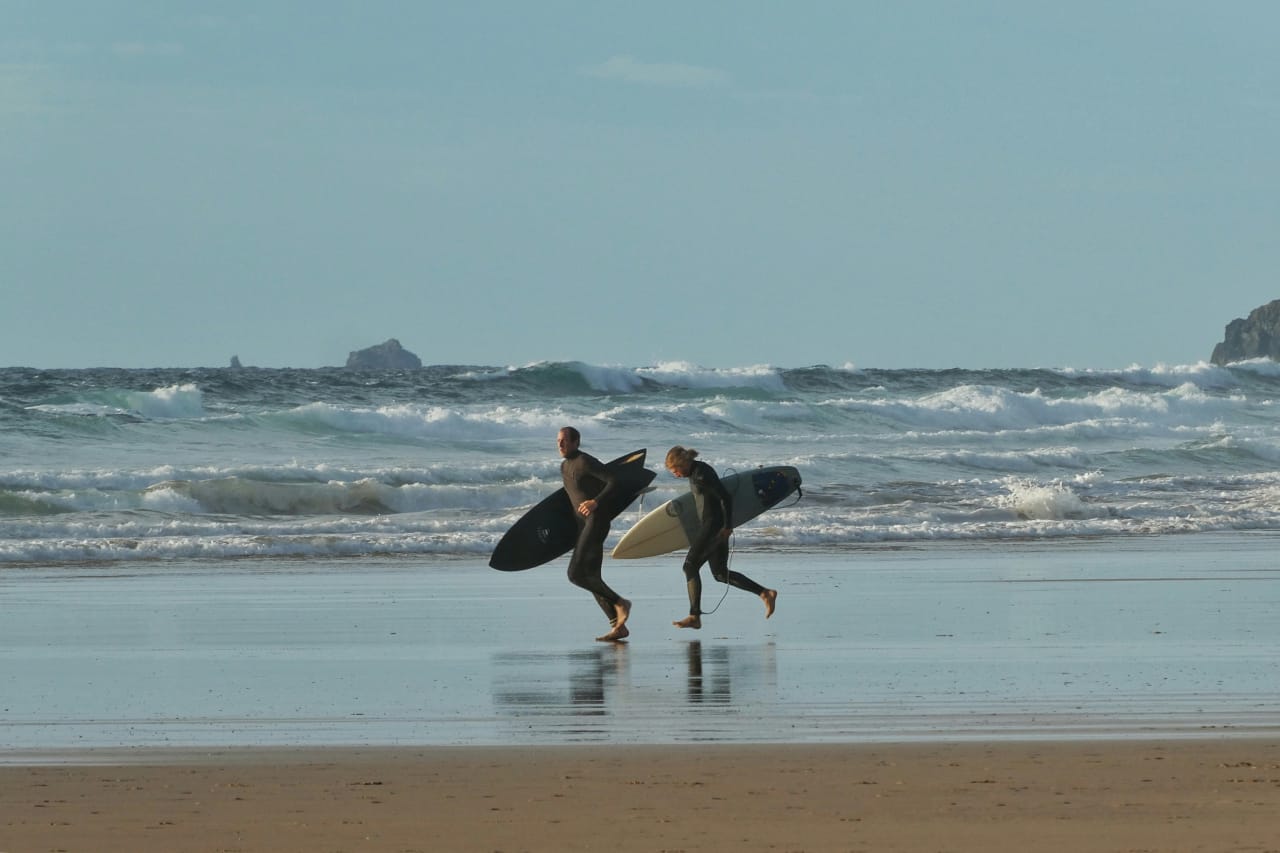
Newquay's surfing reputation traces back to 1962, when a group of Australian lifeguards — among them Bob Head, Ian Tiley, John Campbell and Warren Mitchell — arrived with lightweight fibreglass boards and introduced modern surfing to a coastline that already had the swell for it. The Newquay Surf Life Saving Club followed in 1963, one of the first of its kind in the UK, and Fistral Beach has hosted international competitions ever since — including, in recent decades, Boardmasters.
See the day-to-day version of the town on our news page, or the practical version — services, shops, sport and support — in the A-Z directory. For the coastline itself, see the beach guide.